
Last month I alluded to a tight grouping of galaxies surrounding NGC 910, which lies a little more than a degree from the edge-on spiral NGC 891. This is the Abell 347 galaxy cluster; a grouping of at least a dozen galaxies within the view of a wide field eyepiece. The article The NGC 1023 Galaxy Group on pg. 26 of the December issue of Sky & Telescope magazine takes you on a tour of a much larger galaxy group in this same region.
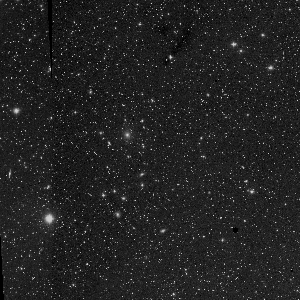
The tour assumes an 18" telescope, but even a 12" will show many of these galaxies on a good night from a dark location.
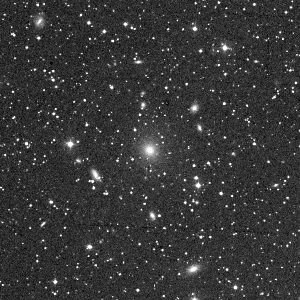
Let's begin our tour with NGC 910. This is the largest and brightest galaxy. Look for it about 1o to the southeast of the much larger NGC 891. This galaxy is relatively easy. It is a typical, round elliptical galaxy with a bright center. It is listed as a 13th magnitude elliptical that is 2' x 2' in diameter. Like most galaxies in this region it lies around 200 million light years away.
I found that 166X worked well for exploring the region so I suggest switching to a higher power eyepiece before proceeding. The immediate vicinity of NGC 910 is rich with tiny galaxies:
UGC 1866 lies to the northwest. This 15th magnitude barred spirals a mere 50" x 30" in diameter and was visible in my 18" only with averted vision as a faint smudge.
NGC 912 lies to the northeast of NGC 910. This 14.8 magnitude galaxy is similar in size to UGC 1866 and is listed as compact galaxy. It is visible as a slightly elongated smudge.
UGC 1858 is a 15.4 magnitude face-on barred spiral and is another faint smudge that required averted vision.
NGC 911 has bright center which is surrounded by relatively bright, round haze. It is listed as a 13.8 magnitude elliptical.
NGC 909 is another relatively easy (14.4 magnitude) elliptical that has a bright center.
NGC 906 appeared a bit fainter than NGC 909 even though it is listed as 13.8 magnitude. It required averted vision. This is a face-on, barred spiral.
MCG 7-6-20 lies to the east and is similar in appearance to NGC 912. It is a 15th magnitude face-on spiral that shows evidence in photographs of interaction with another galaxy.
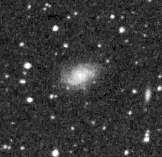
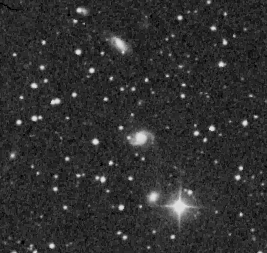
To the northwest of our NGC 910 starting point lies MCG 7-6-6, a difficult object that was only visible with averted vision. It also required more magnification to bring it out (333X did the trick). This was the most difficult galaxy to see. It is listed as a 14.9 magnitude, nearly face-on spiral.
Finally, take a minute to have a look at an interesting asterism of four stars around GSC 2839-1796. They make a tiny, compact box. See the diagram for their location.
Images are from the DSS using SkyView. Charts are from our SkyTools software.