| Jones
1 |
Planetary
Nebula
aka
Jn 1, PN G104.2-29.6, PK 104-29.1, ARO 195
Integrated
Visual Magnitude: 15.1
Apparent
Diameter: 5.3'
Magnitude of central star:
16.1
Distance: 2300 ly
Actual
Diameter: 3.5 ly
Minimum
requirements to view: 6-inch scope and very dark skies |
|
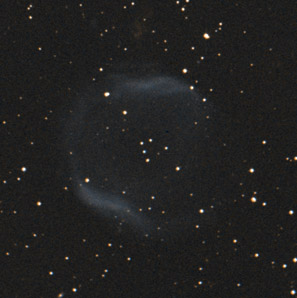 You
won't find this faint low-surface-brightness nebula in Burnham's or
Deep Sky Wonders. Although visible to very experienced
observers as a round haze in scopes as small as 6-inches under very
dark skies, it is the availability of relatively inexpensive large
aperture Dobs and narrow band filters that have made this sort of
low surface brightness object more generally accessible. You
won't find this faint low-surface-brightness nebula in Burnham's or
Deep Sky Wonders. Although visible to very experienced
observers as a round haze in scopes as small as 6-inches under very
dark skies, it is the availability of relatively inexpensive large
aperture Dobs and narrow band filters that have made this sort of
low surface brightness object more generally accessible.
I first tried for this
nebula in my 18-inch without a filter. In my log I wrote:
This one is hard, even
in an 18 inch under dark skies. It appears on photographs as
two opposing lobes that presumably make up a "bubble"
similar to NGC 246. It's sort of like a much smaller
"Cygnus Loop." I used a DSS image to locate the
nebulosity. The northern lobe was distinctly visible at 166X
with averted vision as a ghostly patch of sky. The southern
lobe was more difficult, and only after 45 minutes of chasing it
was I able to convince myself that I could see it at all.
This one isn't for beginners.
More recently I tried it
with the aid of an OIII filter. As is often the case for large
planetaries, an OIII filter made a dramatic difference. With
the OIII in place, what was once only a slight brightening of the
sky became a clearly defined broken ring. Two large, opposite
sections of this ring stand out as brighter than the rest.
With averted vision a faint, round background haze could be seen.
I suggest magnifications from 100x to 200x for the best view.
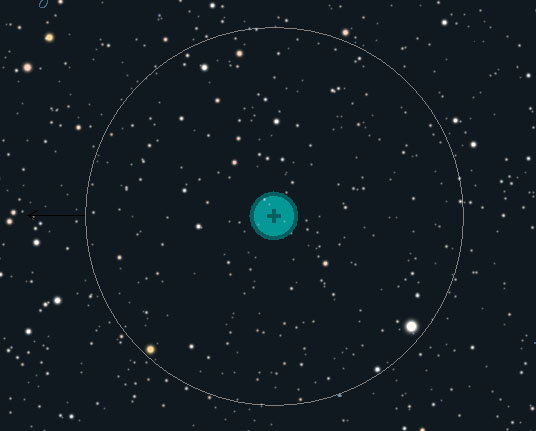
The field in an 18-inch at
94x. North is down and east is to the right.
|
Millennium
Star Atlas Vol III Chart 1162
Sky
Atlas 2000 Chart 9
Uranometria
2000 Vol I Chart 124 |
|
|
|
