Observing Neptune
For any telescope
On August 17, 2009 Neptune reached opposition, marking the arrival of the best time of the year to observe it.
Most observers will be able to view Neptune into November. In August it
was 30 AU from the sun and 29 AU from the earth (1 AU is the distance
between the Earth and Sun). Neptune's brightest
moon, Triton, will be separated from the planet by as much as 17". Shining
at magnitude 13.5, Triton makes a good target for 8-inch or larger telescopes.
Neptune 2009
October 15
| Right
Ascension |
Declination |
Magnitude |
Diameter |
Con |
| 21h44m |
-14o02' |
7.9 |
2.3" |
Cap |
What You Need to Observe
Neptune
You won't need a
dark sky to observe Neptune because it is relatively bright. You will need
finder charts (see below). Any telescope will show it as
a tiny point of light and from a dark site even binoculars will work. A
6-inch or larger scope will show its tiny, 2" blue disk under good seeing
conditions.
Darker skies and/or
an eight-inch or larger telescope will be required to spot the 13.5 magnitude
moon Triton.
Finder Charts

Neptune is currently in Capricornus, not far
from Jupiter.

What You Can Expect to See
 Use
as much magnification as the conditions will bear to see Neptune's tiny blue
disk. At right is a simulation of the appearance of Neptune and Triton in
a 12-inch F/4.5 scope under the best conditions. Neptune's disk can be seen, but it is nonetheless very tiny.
Unfortunately, it will show no detail even in the largest instruments. Use
as much magnification as the conditions will bear to see Neptune's tiny blue
disk. At right is a simulation of the appearance of Neptune and Triton in
a 12-inch F/4.5 scope under the best conditions. Neptune's disk can be seen, but it is nonetheless very tiny.
Unfortunately, it will show no detail even in the largest instruments.
Triton will appear
as a faint star near the planet. Triton's orbit is currently tilted so
that it traces a nearly circular path. As such, it can be observed equally
well on any date. It takes about 6 days for Triton to orbit the planet
once so it will move significantly from one night to the next. Triton's
orbit is retrograde; it orbits in the opposite direction than most moons.
On the diagram below, which has north at the top and east to the left, it orbits
counter clockwise.

What Are You Seeing?
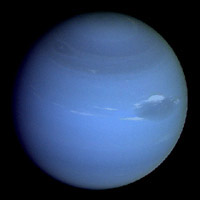 Neptune
was encountered by Voyager 2 in 1989, leaving us a wealth of information
regarding the planet and its satellites. At a distance of over 30
AU this giant planet takes over 160 years to orbit the sun. It won't
be until next year that it will have completed an orbit since its discovery
in 1845. Neptune is some 17 times more massive than the earth and
has a diameter of 49,500 km, nearly four times that of the Earth.
Like Uranus, Neptune is composed of gas above ice above a small rocky core.
The cloud tops we observe in the telescope are composed primarily of methane. Neptune
was encountered by Voyager 2 in 1989, leaving us a wealth of information
regarding the planet and its satellites. At a distance of over 30
AU this giant planet takes over 160 years to orbit the sun. It won't
be until next year that it will have completed an orbit since its discovery
in 1845. Neptune is some 17 times more massive than the earth and
has a diameter of 49,500 km, nearly four times that of the Earth.
Like Uranus, Neptune is composed of gas above ice above a small rocky core.
The cloud tops we observe in the telescope are composed primarily of methane.
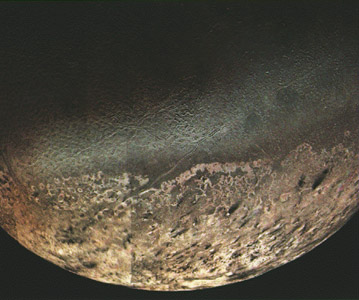
Triton
has a diameter of 2700 km and is probably composed of 75% rock and 25%
water ice. Voyager 2 revealed that the surface of Triton is among
the most interesting of any planet or moon in the solar system. The
surface material is frozen water, nitrogen, methane and carbon dioxide.
Due to its high reflectivity, most of the feeble sunlight that reaches
Triton is reflected back, leaving the surface very cold; only about 35
K (-240o
C, -400o
F). The cold temperatures allow for only a very thin atmosphere of
gaseous nitrogen which is visible in Voyager images as a slight haze.
It is possible that Triton supports volcanoes and "lava" flows consisting
primarily of water rather than rock.
 We
can't say for sure until NASA's New
Horizons probe reaches Pluto in 2015, but it appears that
Triton and Pluto may have a lot in common. In fact, both may be the
leftovers of thousands of such objects that inhabited the early solar system;
Pluto found its way into a stable solar orbit and Triton was captured by
Neptune. Many of the rest are smaller and fainter, so they are only now
being discovered. Others may have been incorporated into planets or ejected
from the solar system. We
can't say for sure until NASA's New
Horizons probe reaches Pluto in 2015, but it appears that
Triton and Pluto may have a lot in common. In fact, both may be the
leftovers of thousands of such objects that inhabited the early solar system;
Pluto found its way into a stable solar orbit and Triton was captured by
Neptune. Many of the rest are smaller and fainter, so they are only now
being discovered. Others may have been incorporated into planets or ejected
from the solar system.
|
